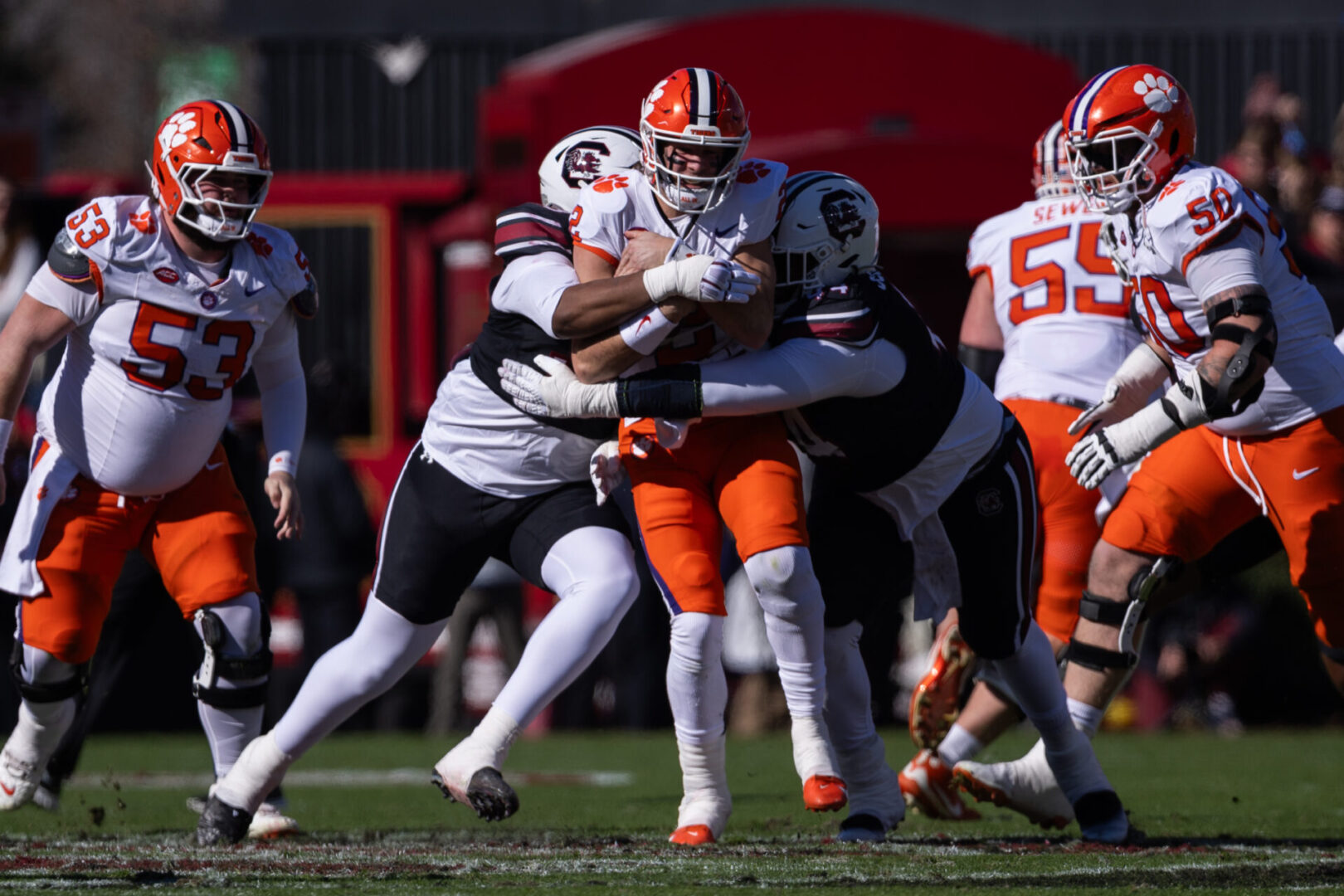
Clemson will be without 26 players for Pinstripe Bowl

Missing players? Dabo says "no one cares"

I think Dabo means nobody is going to sympathize. The only thing that counts in the end is winning or losing with the players who show up.
,
Terry actually made a similar point, and they're both right.

This is why I called the game a joke, which is not the right word to use for the reasons some people here pointed out.

It's not a joke. But it also bears no resemblance to the kind of meaningful game that was once associated with bowls.
 
I think Dabo means nobody is going to sympathize. The only thing that counts in the end is winning or losing with the players who show up.
,
Terry actually made a similar point, and they're both right.

This is why I called the game a joke, which is not the right word to use for the reasons some people here pointed out.

It's not a joke. But it also bears no resemblance to the kind of meaningful game that was once associated with bowls.
Correct. It's the hand that's been dealt, so head into the game prepared to win.
 
And now comes another wild card: snow.

NYC forecast calls for 5 inches overnight tapering off around kick-off time.

Dabo gonna get his southern *** a taste of yankee weather!
Yessir. We had a property in NC, not far from Clemson. There were a few mornings in the teens and maybe 2-3 inches of snow each year, but that was in January and February and I doubt those Clemson guys played much football in those conditions.
 
Did DDS opt out of the bowl game? Would be great to see him play especially with Fisher not playing.

Last report I saw was that DDS (surprisingly) is going to play. I'm guessing he'll be on a play-count.

Same with Kaytron. I can't believe he'll play but if he does, it won't be for anything like the whole game.
 
Yessir. We had a property in NC, not far from Clemson. There were a few mornings in the teens and maybe 2-3 inches of snow each year, but that was in January and February and I doubt those Clemson guys played much football in those conditions.
We used to live in NC. I recall an inch or so of snow would lead to cars spun out all over the roads. Some people drove 10+ miles over the speed limit. Some drove 30 mph on the highways. It was a bad combo.
 
I thought it was that way once across the Mason-Dixon Line. 😏

Having lived in Maryland for 40 years, I think it's generally a true statement that drivers struggle more in winter weather south of the Mason-Dixon Line than north of it...for the simple reason they don't get nearly as much practice.

That said, this is also a bit of an unfair stereotype as, believe me, there are also a lot of bad drivers in yankee land.

Still, I grew up in the hill country of NEPA, 25 miles north of Scrantion, where we used to get roughly 45 inches of snow in a typical winter and so I gained a lot of experience even as a teenager driving in those conditions. In fact, our little town and our house were situated on the side of a mountain where you had to navigate uphill and downhill inclines even to reach Main Street.

Therefore, I learned a key life lesson about driving in snow early on when I started down one of those inclines on a snowy evening and the car began to slide. The brakes were only making things worse so in desperation I took my foot off the brake and...what do you know!!...the car straightened out!!

This is something that a lot of people never get, especially if they don't drive in snow much. I mean, it's counter-intuitive. The instinct is to press down harder on the brakes. Of course, it's also critical that you don't put yourself in situations, where you need to jam down the brakes. Maintain your interval with the car in front of you...and anticipate stuff before it happens.

Of course another issue is the prevalence of 4-wheel drive vehicles -- I've never owned one myself -- which gives some drivers a sense of misplaced confidence...as if they're immune to the rules of safe winter driving. No question, such vehicles handle snow better but a lot of people find out the hard way that they're no guarantee of anything on snow-covered or icy roads.
 
Having lived in Maryland for 40 years, I think it's generally a true statement that drivers struggle more in winter weather south of the Mason-Dixon Line than north of it...for the simple reason they don't get nearly as much practice.

That said, this is also a bit of an unfair stereotype as, believe me, there are also a lot of bad drivers in yankee land.

Still, I grew up in the hill country of NEPA, 25 miles north of Scrantion, where we used to get roughly 45 inches of snow in a typical winter and so I gained a lot of experience even as a teenager driving in those conditions. In fact, our little town and our house were situated on the side of a mountain where you had to navigate uphill and downhill inclines even to reach Main Street.

Therefore, I learned a key life lesson about driving in snow early on when I started down one of those inclines on a snowy evening and the car began to slide. The brakes were only making things worse so in desperation I took my foot off the brake and...what do you know!!...the car straightened out!!

This is something that a lot of people never get, especially if they don't drive in snow much. I mean, it's counter-intuitive. The instinct is to press down harder on the brakes. Of course, it's also critical that you don't put yourself in situations, where you need to jam down the brakes. Maintain your interval with the car in front of you...and anticipate stuff before it happens.

Of course another issue is the prevalence of 4-wheel drive vehicles -- I've never owned one myself -- which gives some drivers a sense of misplaced confidence...as if they're immune to the rules of safe winter driving. No question, such vehicles handle snow better but a lot of people find out the hard way that they're no guarantee of anything on snow-covered or icy roads.
The foot off the break is really the concept of the coefficient of static friction being higher than that of kinetic friction. Essentially as your wheels roll, they make contact with the road surface and remain in contact throughout the entire time that this portion of the tire touches that road surface. If you break, your wheel is no longer rolling. Therefore, the portion of the tire in contact with the road surface slides along the road surface. The frictional force (static friction) that keeps you from sliding is higher when your wheels are rolling.

This is also the concept behind anti-lock breaking. For ABS, the breaking is done in very small increments very quickly alternating between rolling and the breaking (microseconds). This keeps your tire and the road surface in the higher coefficient of static friction for longer.

It is also the reason why you should go slower downhill and into a curve but not be breaking hard downhill and during the curve. You slow before the curve, before the downhill or periodically and briefly down the hill. You do not want to be in a position where you need to break hard down the hill. The act of breaking and the harder that you break is correlated to more sliding. This also brings in the concept of conservation of momentum on hills because up a hill, you are gaining potential energy by virtue of moving to a higher point which naturally reduces your kinetic energy. Therefore, you can have a faster velocity into the hill if you are going up it without sliding as much. But down the hill, you better be going much slower before the hill because you are losing potential energy as you move down the hill which is converted into kinetic energy thereby increasing your speed probably unwantedly. Further, as you are traveling in a curve, you are experiencing a higher acceleration which is the change in velocity (a vector quantity where direction matters) and that change of direction yields a higher (angular) acceleration. So you don't want to go fast IN the curve because you are already experiencing a higher acceleration which requires a higher force to hold your tires to your desired path. Instead, break to slow BEFORE the curve and go through that curve at a lower speed to reduce that acceleration.

You will now return to your original programming.
 
The foot off the break is really the concept of the coefficient of static friction being higher than that of kinetic friction. Essentially as your wheels roll, they make contact with the road surface and remain in contact throughout the entire time that this portion of the tire touches that road surface. If you break, your wheel is no longer rolling. Therefore, the portion of the tire in contact with the road surface slides along the road surface. The frictional force (static friction) that keeps you from sliding is higher when your wheels are rolling.

This is also the concept behind anti-lock breaking. For ABS, the breaking is done in very small increments very quickly alternating between rolling and the breaking (microseconds). This keeps your tire and the road surface in the higher coefficient of static friction for longer.

It is also the reason why you should go slower downhill and into a curve but not be breaking hard downhill and during the curve. You slow before the curve, before the downhill or periodically and briefly down the hill. You do not want to be in a position where you need to break hard down the hill. The act of breaking and the harder that you break is correlated to more sliding. This also brings in the concept of conservation of momentum on hills because up a hill, you are gaining potential energy by virtue of moving to a higher point which naturally reduces your kinetic energy. Therefore, you can have a faster velocity into the hill if you are going up it without sliding as much. But down the hill, you better be going much slower before the hill because you are losing potential energy as you move down the hill which is converted into kinetic energy thereby increasing your speed probably unwantedly. Further, as you are traveling in a curve, you are experiencing a higher acceleration which is the change in velocity (a vector quantity where direction matters) and that change of direction yields a higher (angular) acceleration. So you don't want to go fast IN the curve because you are already experiencing a higher acceleration which requires a higher force to hold your tires to your desired path. Instead, break to slow BEFORE the curve and go through that curve at a lower speed to reduce that acceleration.

You will now return to your original programming.

Good stuff. But let's not go back to original programming yet. I wish to discourse further on the subject of driving.

It should be noted that at a certain point in a skid on slippery roads, it becomes too late to pull out so the trick is to manage the braking action before that point is reached.

Speaking of brakes, I recently took our vehicle over for the annual inspection this state ridiculously requires and the mechanic was absolutely marveling at the great condition of my original brakes after 70,000 miles of driving. He said at the current rate of wear I might not even need to replace the brakes until 125,000 miles or even more. In fact, we traded in our last car with 110,000 miles and had never once replaced the original brakes.

When I taught our kids to drive, I told them that you control the speed of the vehicle as much or more with the gas pedal as with the brakes. You don't need to be constantly braking if you're paying attention and maintaining proper interval.

As it is, we live in town but near a rural and hilly area so do a fair amount of driving on those roads and in my observation the majority of drivers don't understand that there's no need to brake every time you go around a curve or down a hill. Honestly, I've driven my wife crazy making this common-sense observation. As I get older, now having driven literally one million miles during the course of my life, I find myself getting less patient with drivers who do not meet my standard of excellence.

Then again, another thing I taught my kids is that no matter how good a driver you are, you will inevitably at one time or another over the course of long years either; A) do something dumb; or B) find yourself in a situation not of your own making where you're saved (or not) by dumb luck. However, if you follow some basic rules of driving, you will improve your overall chances while making (A) and (B) less likely.
 
Good stuff. But let's not go back to original programming yet. I wish to discourse further on the subject of driving.

It should be noted that at a certain point in a skid on slippery roads, it becomes too late to pull out so the trick is to manage the braking action before that point is reached.

Speaking of brakes, I recently took our vehicle over for the annual inspection this state ridiculously requires and the mechanic was absolutely marveling at the great condition of my original brakes after 70,000 miles of driving. He said at the current rate of wear I might not even need to replace the brakes until 125,000 miles or even more. In fact, we traded in our last car with 110,000 miles and had never once replaced the original brakes.

When I taught our kids to drive, I told them that you control the speed of the vehicle as much or more with the gas pedal as with the brakes. You don't need to be constantly braking if you're paying attention and maintaining proper interval.

As it is, we live in town but near a rural and hilly area so do a fair amount of driving on those roads and in my observation the majority of drivers don't understand that there's no need to brake every time you go around a curve or down a hill. Honestly, I've driven my wife crazy making this common-sense observation. As I get older, now having driven literally one million miles during the course of my life, I find myself getting less patient with drivers who do not meet my standard of excellence.

Then again, another thing I taught my kids is that no matter how good a driver you are, you will inevitably at one time or another over the course of long years either; A) do something dumb; or B) find yourself in a situation not of your own making where you're saved (or not) by dumb luck. However, if you follow some basic rules of driving, you will improve your overall chances while making (A) and (B) less likely.
It does always amaze me how many times in perfect conditions someone is riding the breaks down a long hill only to have to hit the gas pedal to go up the other side. It's like they have no concept of using the momentum down the hill to overcome the uphill. I get if there is a hazard or a redlight at the bottom of the hill. I just don't understand people that want to have a foot on the breaks and/or the gas at all times. It's so inefficient and costly.

Don't get me started on the people that want to sit in the left lane on a highway driving for 5 minutes beside a tractor trailer that may or may not see them in their rear-view mirror. That left blinker can go on at any time with no guarantee that they see you. I saw a van rolled that way when I was young. The truck had no idea they were even there, and the van ended up getting pushed off the highway. Also, I would like to pass please and then get back over if there is room.
 
Last edited:
The thing is that both BYU and Vanderbilt would belong in before Notre Dame this year anyway. Notre Dame only beat one ranked team all season. The only team BYU lost to this season was the #4 team in the country. And Vanderbilt had an identical record while playing an SEC schedule.

No Tulane, No JMU, and No Notre Dame. They don't play a power 4 conference schedule. They are the next tier down. There should be a separate playoff for non-power 4 teams. It can have Tulane, JMU, Notre Dame, Navy, etc.
And no Boise.
 
Winter storm watch up for New York with 4-8 inches of snow expected starting Friday afternoon and tapering off Saturday morning.

Cloudy conditions at kick-off with wind chill 22 degrees and a 10-mph hour breeze out of the northeast.
 
What will Penn State DE be? Kemajou, DDS maybe. This is probably going to be high scoring game, depending on weather I guess.
 
What will Penn State DE be? Kemajou, DDS maybe. This is probably going to be high scoring game, depending on weather I guess.
I believe DDS said he was playing. Also Kemajou, Harvey who both played a good bit this year. Malichi Williams played some and likely will get snaps in this game. Enai White, who moved from DE to DT mid season could also play both positions if needed. Don't know if Mason Robinson is healthy yet. Both true freshmen Cortez Harris and Dayshaun Burnett could also play if they are healthy.

It would seem that DDS, Kemajou, Harvey and Williams will get most of the snaps, but who knows......
 
Last report I saw was that DDS (surprisingly) is going to play. I'm guessing he'll be on a play-count.

Same with Kaytron. I can't believe he'll play but if he does, it won't be for anything like the whole game.
If the field is a mess because of snow and I was coaching. I'd tell DDS & Katron to sit the entire game out.
 
Back
Top